
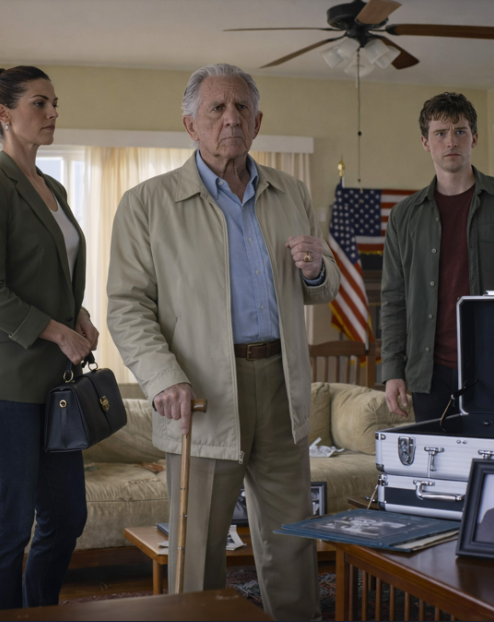
Tiffany stand wie erstarrt da, eine Rolle Papierhandtücher in der Hand, die Augen vor Entsetzen geweitet.
Einen Moment lang geschah nichts.
Precious blickte auf, leckte sich die Lefzen, wedelte mit ihrem Stummelschwanz und wartete auf mehr.
Dann nieste sie.
Es begann mit einem Niesen, dann einem Husten, dann einem hohen Keuchen. Die Beine des Hundes versteiften sich. Sie fiel auf die Seite und strampelte mit den Beinen in der Luft, als rannte sie im Traum.
Schaum blubberte an ihren Wangen. Ihre Augen verdrehten sich.
Tiffany sank auf die Knie und schrie den Namen des Hundes. Sie versuchte, das Tier festzuhalten, aber Precious wehrte sich heftig und kratzte mit ihren Krallen den Linoleumboden.
Eine Minute verging. Das Toben ließ nach.
Zwei Minuten. Das Keuchen ging in ein Gurgeln über.
Drei Minuten.
Der Hund versteifte sich ein letztes Mal, dann wurde sie schlaff.
Die Stille, die darauf folgte, war erdrückend und absolut.
Precious lay dead on the kitchen floor, her tongue lolling out amidst the shards of the broken bowl.
I looked at the dead animal.
Then I looked up at my son.
“What happened to the dog, Terrence?” I asked, my voice trembling with a fear that I didn’t have to fake. “Why did she die?”
Terrence stared at the dog, his face draining of color until he looked like a corpse himself. He looked at the empty packet peeking out of Tiffany’s apron pocket, then back at the dead animal.
He swallowed hard.
“She had a cold,” he whispered, his voice barely audible. “She was sick. It was just a seizure, Dad. Just a cold.”
He lied.
I knew he lied.
And looking into his terrified eyes, I knew he knew that I knew that soup wasn’t meant to help me sleep.
It wasn’t meant to make me compliant.
It was meant to stop my heart.
The sun rose gray and sickly over the city, matching the feeling in the pit of my stomach.
I had survived the night by pushing a heavy dresser in front of my bedroom door and sleeping with one eye open, my hand under the pillow gripping the cold steel of my revolver.
But morning brought a new danger.
Terrence banged on my door at seven sharp. His voice was tight with a forced cheerfulness that sounded like a violin string about to snap.
“Get dressed, Dad!” he shouted through the wood. “We have that appointment.”
I moved the dresser slowly, making enough noise to sound like an old man struggling.
I opened the door and saw him.
He looked worse than I did. His eyes were bloodshot, and he smelled of mints trying to cover the scent of last night’s whiskey.
He ushered me out to his car—a leased luxury sedan that was two months behind on payments.
I sat in the passenger seat, clutching my cane, watching the familiar streets of my neighborhood fade away.
I expected us to turn toward the city center, toward the hospital district where the real doctors practiced.
But Terrence turned left toward the industrial park, toward the part of town where the streetlights were broken and the storefronts were boarded up with plywood.
“Where are we going, son?” I asked, my voice trembling just the right amount. “The hospital is the other way.”
Terrence gripped the steering wheel so hard the leather creaked.
“We are going to a specialist, Dad,” he said, his eyes fixed on the road. “A private practitioner. He is the best. He will get you that certificate in no time.”
I looked out the window at the graffiti-stained walls and the piles of trash on the curb.
A specialist.
Sure.
A specialist in no-questions-asked work.
We pulled up to a brick building that looked like it had been condemned ten years ago. There was no sign, just a metal door with peeling green paint.
Terrence hurried me out of the car, looking over his shoulder as if he expected the devil himself to be following us.
We walked inside.
The waiting room smelled of mildew and stale cigarette smoke. There were no magazines. There was no receptionist. Just a flickering fluorescent light that buzzed like a dying fly.
A door opened and a man stepped out.
He was wearing a white coat, but it was stained yellow at the cuffs. He was short, balding, and sweating profusely despite the chill in the room.
I recognized him, not as a doctor, but from the photos Vance had shown me.
This was Doc Miller—a disgraced veterinarian who had lost his license for selling ketamine to local dealers.
He was Terrence’s poker buddy.
“Ah, Mr. King,” Miller said, wiping his damp hands on his coat. “Please come in. We have everything ready.”


