
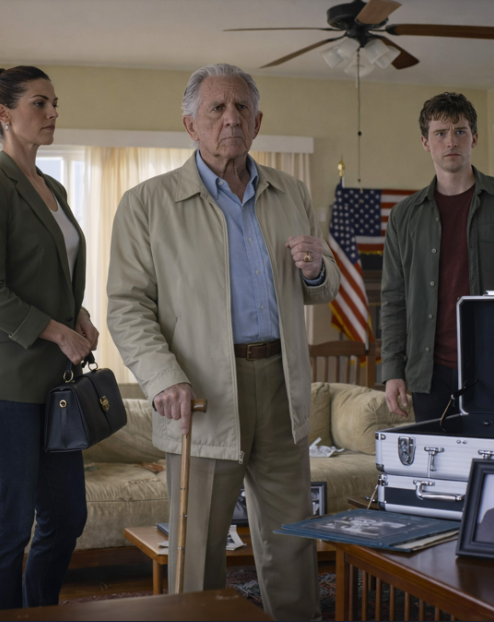
I stopped, panting, my hand on the gun.
“If you kill him now, you go to prison and he wins,” Vance said, stepping forward, his hands raised. “You will rot in a cell and Tiffany will spend that money on vacations and jewelry. Is that what Esther would want?”
I looked at the photo of my son. The monster.
“Then what do I do?” I asked, my voice breaking.
“We trap him,” Thorne said. His eyes were cold and hard. “We make him confess. We make him destroy himself.”
“But to do that, you have to go back there.”
“Go back?” I asked. “To that house—with him?”
“Yes,” Thorne said. “You have to go back. You have to play the grieving, confused old man. You have to make him think he has won. You have to make him think you are weak.”
“Can you do that, Booker? Can you look the man who murdered your wife in the eye and pretend you do not know?”
I looked at the journal. I looked at the photos. I thought about Esther. I thought about the fear she must have felt in those final days.
I took a deep breath. I straightened my jacket. I picked up my cane.
I was a soldier once. I know how to follow orders.
And I know how to wait for the kill shot.
“I will do it,” I said.
Thorne nodded. “Good. Now listen carefully. Here is what we are going to do.”
And as he laid out the plan, I felt the old soldier inside me waking up.
My son thought he was a predator.
He thought I was prey.
He was about to find out that he had walked into the den of a lion.
Thorne pushed the small black leather journal across the mahogany desk toward me. It smelled of lavender—the scent Esther always wore. My hands trembled as I opened it. The handwriting was hers. Neat loops I had known for 45 years, but the words were strangers to me.
I started reading.
“March 12th. Mr. Thorne’s portfolio is up 12% this quarter. My recommendations on the tech startups paid off.”
I stared at the page.
Recommendations.
My Esther—the woman who clipped coupons for canned corn—was giving investment advice to a billionaire.
I looked up at Thorne. He nodded.
“Esther was not just my housekeeper, Booker. She was my financial compass. She had a gift. She saw patterns in the market no one else saw. Over 30 years, I paid her a commission on every successful trade.”
I turned the page.
A bank statement was pasted there. The balance made my breath hitch.
Three million dollars.
My wife was a millionaire.
She had built a fortune in silence, scrubbing floors by day and studying markets by night.
But as I flipped forward, the tone of the entries changed. The ink became jagged.
“January 4th. I found another withdrawal. $2,000. The signature looks like mine, but the loop on the E is wrong. It is Terrence. I know it is him.”
“February 10th. $5,000 this time. I confronted him. He denied it. He screamed at me. He said I owed him.”
I looked at the total loss calculated at the bottom of the page.
$50,000 in two years.
My son had been bleeding his mother dry while driving a leased Mercedes and wearing Italian suits.
The shame burned in my chest hotter than the grief. She never told me. She carried this burden alone to protect me from the truth about our boy.
She died trying to save our savings from his greed.
Vance, the private investigator, stepped forward, his trench coat rustling. He laid out a series of high-resolution photographs on the desk. They were taken with a night vision lens—grainy and green—but clear enough to stop my heart.
“Mr. King, look at the timestamp. 2:14 a.m. Three days before your wife passed.”
The photo showed my kitchen. The checkered curtains Esther sewed herself were visible. And there was Terrence. He was standing by the counter where Esther kept her daily pill organizer. In his hand, he held a small amber vial. It looked identical to her heart medication.
But in the next photo, he was pouring the contents of that vial into her organizer and pocketing her real pills.
Vance pointed a calloused finger at the image. “We analyzed the trash from your curb the next morning. We found the vial he threw away. It did not contain beta blockers. It contained a concentrated stimulant—a high-grade amphetamine mixture dangerous enough to cause cardiac arrest in a healthy man. Fatal for someone with your wife’s condition.”
Thorne spoke up, his voice like gravel. “It was not a heart attack, Booker. It was murder. Calculated.”
He waited until her prescription was low.
Then he made the switch.
He knew exactly what he was doing.
He watched her take those pills.
He watched her die.
And he did it for money.
He did it because she was about to cut him off.
I looked at the photo of my son. His face was illuminated by the refrigerator light. He was not crying. He was not hesitating. He was smirking.
The monster who lived in my house.
The boy I taught to ride a bike.
He had poisoned the woman who gave him life because he wanted a payout.
He traded his mother’s life for a gambling debt.
It was not natural causes.
It was an execution carried out in our own kitchen.
A sound escaped my throat. It was low and guttural—pure animal pain.
The room spun. I grabbed the edge of the desk so hard the wood creaked. My vision blurred with red-hot tears.
I stood up, knocking the heavy leather chair backward.
I could feel the weight of the service pistol in the glove box of my truck. It was calling to me.
I needed it.
I needed to feel the recoil.
Wenn du fortfahren möchtest, klicke unten auf die Schaltfläche „Weiter“ ⤵

